Disability History in the USA
The rights families rely on today — the IEP, the 504 Plan, accessible classrooms — were won by a movement within living memory. This timeline traces two centuries of that struggle, from the first special schools to the ADA and beyond.
Early Schools & Reform
1817–1870sBefore public schools served them, most disabled Americans were kept at home or in poorhouses. The first dedicated schools — and the first reformers — began to change that.
1817
American School for the Deaf opens
Founded in Hartford, Connecticut by Thomas Hopkins Gallaudet, Laurent Clerc, and Mason Cogswell — the first permanent school for students with disabilities in the United States, and the seed of American Deaf education and sign language.
Source: American School for the Deaf1832
Perkins School for the Blind
Samuel Gridley Howe's school in Watertown, Massachusetts pioneers education for students who are blind. Anne Sullivan — later Helen Keller's teacher — is among its most famous graduates.
Source: Perkins School for the Blind — Our History1840s
Dorothea Dix's asylum reform
After documenting the jailing and neglect of people with mental illness, Dix persuades legislatures to build more than 30 state hospitals and launch the 'moral treatment' reform movement.
Source: Dorothea Dix — Wikipedia
Exclusion & the Eugenics Era
1870s–1940sAt the same time, a darker current took hold: laws and court decisions that treated disability as something to segregate, exclude, and even eliminate.
1882
Immigration exclusion
Federal immigration law bars people likely to become a 'public charge,' turning away countless disabled immigrants at ports like Ellis Island for decades.
Source: Immigration Act of 1882 — WikipediaLate 1800s
'Ugly laws' target disabled people
Some cities pass ordinances criminalizing the public appearance of people whose bodies were considered 'unsightly' — a legal low point that stayed on some books into the 20th century.
Source: Ugly law — Wikipedia1927
Buck v. Bell
The U.S. Supreme Court upholds the forced sterilization of people with disabilities. Tens of thousands of Americans — disproportionately in institutions — are sterilized under such laws over the following decades.
Source: Buck v. Bell — Wikipedia
Families Organize
1940s–1960sAfter World War II, veterans with disabilities and parents of disabled children began demanding services — and building organizations that still exist today.
1949
United Cerebral Palsy founded
Parents, led by Leonard and Isabelle Goldenson, found UCP after being turned away by doctors and schools — one of the first parent-run disability organizations.
Source: About UCP — Our History1950
The Arc begins
Parents of children with intellectual disabilities form what becomes The Arc, fighting against institutionalization and for education at a time when most states offered neither.
Source: The Arc's History1962
Ed Roberts enrolls at Berkeley
A polio survivor who uses an iron lung part of the day, Roberts fights for admission to UC Berkeley and lives in the campus hospital — sparking the Physically Disabled Students Program and the independent living movement.
Source: Ed Roberts (activist) — Wikipedia1963
Community mental health act
President Kennedy — whose sister Rosemary had an intellectual disability — signs the first federal law shifting care from large institutions toward community-based services.
Source: Community Mental Health Act — Wikipedia
Rights Won in Court & Congress
1970–1975In just five years, disability advocates won landmark court rulings and the first federal laws guaranteeing education — the direct ancestors of today's IEP.
1971–72
PARC & Mills: the right to an education
Courts in Pennsylvania (PARC) and Washington, D.C. (Mills) strike down the exclusion of disabled children from public schools — establishing that education is a right, not a privilege.
Source: Public Interest Law Center — PARC v. Pennsylvania1972
Willowbrook exposed
A television investigation reveals thousands of children living in filth at the Willowbrook State School on Staten Island, New York. The resulting consent decree becomes a national model for deinstitutionalization.
Source: Willowbrook State School — Wikipedia1973
Section 504 of the Rehabilitation Act
The first federal civil rights protection for people with disabilities: any program receiving federal money — including public schools — may not discriminate. The legal foundation for today's 504 Plans.
Source: U.S. Department of Labor — Section 5041975
Education for All Handicapped Children Act
Congress guarantees a free appropriate public education (FAPE) to every child — the law renamed the Individuals with Disabilities Education Act (IDEA) in 1990.
Source: IDEA — U.S. Department of Education
Sit-ins & Independent Living
1977–1988The government dragged its feet on enforcing the new laws — so disabled activists occupied federal buildings and built their own services.
1977
The 504 sit-ins
When regulations implementing Section 504 stalled, activists occupied federal offices nationwide. The San Francisco sit-in lasts 26 days — the longest occupation of a federal building in U.S. history — until the regulations are signed unchanged.
Source: Patient No More — Longmore Institute on Disability1978
Independent living centers funded
The first federal funding goes to centers for independent living — organizations run by and for disabled people, an idea born from Ed Roberts's Berkeley community.
Source: Independent living — Wikipedia1988
Deaf President Now
Students at Gallaudet University — the world's only Deaf university, chartered by Congress in 1864 — shut down the campus until a Deaf president is appointed, a turning point for Deaf pride and self-determination.
Source: Deaf President Now — Wikipedia
The ADA & the 1990s
1990–1999Disability rights went mainstream — televised protests pushed the Americans with Disabilities Act onto the books, and the courts began applying it.
1990
Capitol Crawl & the ADA
Activists abandon their wheelchairs and crawl up the U.S. Capitol steps to shame stalled legislation. On July 26, 1990, President George H.W. Bush signs the Americans with Disabilities Act — 'Let the shameful wall of exclusion finally come tumbling down.'
Source: ADA.gov1990
IDEA is born
The 1975 education law is renamed the Individuals with Disabilities Education Act and adds autism and traumatic brain injury as disability classifications.
Source: IDEA — U.S. Department of Education1999
Olmstead v. L.C.
The Supreme Court rules that unjustified segregation of people with disabilities is discrimination — the 'integration mandate' behind the shift to community-based services.
Source: Olmstead v. L.C. — Wikipedia
Modern Milestones
2000–todayThe fight continues in classrooms, workplaces, and online — with recent laws and rulings shaping the services your family uses today.
2008
ADA Amendments Act
Congress broadens the definition of 'disability' so that courts can no longer exclude people with epilepsy, diabetes, autism, and other conditions from ADA protection.
Source: ADA Amendments Act of 2008 — Wikipedia2010
Rosa's Law
Named for 9-year-old Rosa Marcellino, the law removes the terms 'mental retardation' and 'retarded' from federal statutes and regulations in favor of 'intellectual disability.'
Source: Rosa's Law — Wikipedia2014
ABLE Act & WIOA
Families gain tax-advantaged ABLE savings accounts that don't jeopardize disability benefits, and the Workforce Innovation and Opportunity Act strengthens transition-to-work services for youth.
Source: ABLE National Resource Center2017
Endrew F. v. Douglas County
The Supreme Court unanimously raises the bar for special education: schools must offer an IEP 'reasonably calculated to enable a child to make progress appropriate in light of the child's circumstances' — more than minimal progress.
Source: Endrew F. v. Douglas County — WikipediaToday
An ongoing movement
Advocates continue pushing to phase out subminimum wage, expand accessible technology, and recognize neurodiversity — while disability pride month (July) celebrates a culture and community, not just a law.
Source: Disability Visibility Project
People who changed the story
A few of the many leaders, organizers, and pioneers behind these milestones.
Ed Roberts
Father of Independent Living
After polio, Roberts fought his way into UC Berkeley and went on to lead California's rehabilitation agency — insisting that disabled people belong in the community, not institutions.
Source: Ed Roberts (activist) — WikipediaJudy Heumann
Disability rights leader
A key organizer of the 504 sit-in and a founder of the independent living movement, Heumann served in the U.S. Department of Education and later the Obama administration.
Source: Judy Heumann — WikipediaJustin Dart, Jr.
Godfather of the ADA
Dart crossed the country gathering testimony about discrimination, building the record that convinced Congress to pass the ADA. He sat on the dais when it was signed.
Source: Justin Dart Jr. — WikipediaHelen Keller
DeafBlind author & activist
Radical for her time, Keller reshaped public perceptions of disability, helped found what became the ACLU, and advocated worldwide for people who are blind.
Source: Helen Keller — WikipediaLaurent Clerc
Pioneer of Deaf education
A Deaf teacher from France who co-founded the American School for the Deaf in 1817, bringing sign language methods that shaped American Deaf culture and ASL.
Source: Laurent Clerc — WikipediaEunice Kennedy Shriver
Founder of Special Olympics
Starting with a summer camp in her backyard in 1962, Shriver built Special Olympics into a global movement of sports and acceptance for athletes with intellectual disabilities.
Source: Eunice Kennedy Shriver's Story — Special OlympicsSister movements & a more inclusive society
Disability rights didn't happen in a vacuum. It was shaped by — and helped shape — the other great rights movements of the last century, all pushing toward the same goal: a society where everyone belongs.
The Civil Rights Movement
1950s–1960sDisability rights advocates borrowed the civil rights movement's playbook — sit-ins, marches, and litigation. The NAACP's legal strategy in Brown v. Board of Education (1954) inspired the lawsuits that became Section 504 and IDEA, and the argument that separate is not equal applied just as powerfully to segregated special education. During the 1977 Section 504 sit-in, the Black Panther Party helped deliver food and supplies to keep the occupation alive — one of the movement's most enduring acts of solidarity.
The Women's Rights Movement
1960s–1970sDisability rights and women's rights grew up together in the 1960s and 70s. Women with disabilities faced double discrimination — excluded from both mainstream society and a women's movement that often overlooked them. Disabled women pushed both movements to widen their definition of equality, and shared strategies with leaders like Judy Heumann, whose fight to become a teacher ('if I can't teach, I won't be able to work') echoed the era's broader demand that jobs and schools open to everyone. Title IX's 1972 guarantee of equal access extended to students with disabilities too.
Gay & Trans Rights
1969–todayThe Stonewall uprising of 1969 and the disability rights movement rose from the same era of claiming visibility. Queer activists — including Harvey Milk and organizations in San Francisco's Castro — supported the 1977 504 sit-in, and many disabled activists were themselves part of both communities. Today the movements share common ground: the right to make decisions about one's own body, to be free from discrimination in school, work, and health care, and to be seen as whole people. Both continue to fight for a society built around acceptance rather than correction.
Building a More Inclusive Society
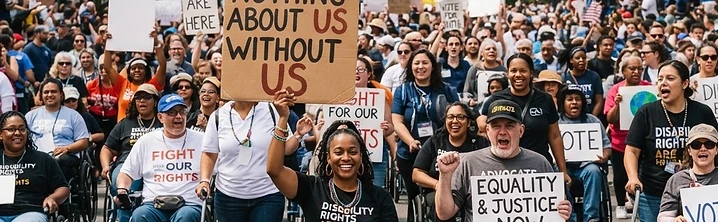
OngoingThe idea that unites all of these movements is simple: society should be built so everyone belongs. 'Universal design' — curb cuts, captions, ramps, flexible work — turns out to help everyone: parents with strollers, workers with injuries, and students of every kind. Inclusive classrooms benefit all students, not just those with IEPs. 'Nothing about us without us' applies to every community that has ever been excluded. Every gain by one movement — civil, women's, gay, trans, disability — has made the next one easier.
Moments the movements shared
1954
Brown v. Board of Education — 'separate is not equal' later anchors disability rights lawsuits
1963
March on Washington — the model of mass, visible protest
1969
Stonewall uprising — the start of the modern gay & trans rights movement
1972
Title IX — equal access in education, including for students with disabilities
1973
Section 504 — disability joins race, sex, and age in federal civil rights law
1977
504 sit-in — civil rights, labor, women's, and gay rights groups all support the occupation
1990
ADA — 'the Emancipation Proclamation' for people with disabilities
Disability on the page, stage & screen
From Oscar winners to classroom novels, disability has slowly moved from being a plot device to being a story told by disabled people themselves. Here are some of the award-winning milestones.
Movies
Johnny Belinda
Jane Wyman won the Best Actress Oscar for playing a Deaf woman — one of the first Oscar-winning disability roles, though Deaf actors themselves wouldn't get that chance for decades.
Children of a Lesser God
Marlee Matlin, who is Deaf, became the first — and still the only — Deaf performer to win the Best Actress Oscar.
Rain Man
Dustin Hoffman won Best Actor for his portrayal of an autistic savant; the film won Best Picture and put autism in the national conversation.
My Left Foot
Daniel Day-Lewis won Best Actor as painter Christy Brown, who had cerebral palsy, in a film based on Brown's own memoir.
A Beautiful Mind
Best Picture winner about mathematician John Nash and life with schizophrenia — a rare mainstream depiction of mental illness with empathy.
The Theory of Everything
Eddie Redmayne won Best Actor as physicist Stephen Hawking; Hawking himself approved the portrayal of life with ALS.
CODA
The story of a hearing child of Deaf adults won Best Picture, and Troy Kotsur — who is Deaf — won Best Supporting Actor, joining Marlee Matlin as the only Deaf Oscar winners.
The Whale
Brendan Fraser won Best Actor as a disabled, housebound teacher — though the film also renewed debate about fat suits and non-disabled actors taking disabled roles.
TV & Stage
Children of a Lesser God (Broadway)
Mark Medoff's play about a Deaf woman and her hearing teacher earned a Tony Award and launched the career of Deaf actor Phyllis Frelich.
Born This Way (A&E)
The Emmy-winning reality series following young adults with Down syndrome — starring a cast with Down syndrome, not actors playing them.
The Curious Incident of the Dog in the Night-Time
The stage adaptation of Mark Haddon's novel about an autistic teenager won five Tony Awards, including Best Play.
Speechless (ABC)
A family sitcom centered on a teen with cerebral palsy, starring Micah Fowler, an actor who has CP.
Atypical (Netflix)
A coming-of-age series about an autistic teen, which added autistic writers and actors with autism in response to community feedback.
Special (Netflix)
Ryan O'Connell — a gay writer with cerebral palsy — created and starred in this Emmy-nominated comedy drawn from his own life.
Books
The Story of My Life
Helen Keller's autobiography became an international classic, written by a DeafBlind woman who had been told her story didn't matter.
Flowers for Algernon
Daniel Keyes's novel about an intellectually disabled man given experimental genius won the Hugo and Nebula awards and is taught in classrooms to this day.
Wonder
R.J. Palacio's novel about a boy with a facial difference became a worldwide bestseller and a film, sparking the 'choose kind' movement in schools.
El Deafo
Cece Bell's graphic memoir about growing up hard of hearing won a Newbery Honor and an Eisner Award — written and drawn by a Deaf author.
Out of My Mind
Sharon M. Draper's novel about a girl with cerebral palsy who cannot speak but has a photographic memory has won multiple children's literature awards.
Being Heumann
Disability rights leader Judy Heumann's memoir — subtitled 'An Unrepentant Memoir of a Disability Rights Activist' — became a bestseller and is now taught in disability studies courses.
Authentic casting
For most of film history, disabled characters were played by non-disabled actors — called 'cripping up' by critics. Studies by the Ruderman Family Foundation and USC Annenberg have found disabled actors play only a small fraction of disabled roles, even though people with disabilities are the largest minority in the U.S.
Representation behind the camera
Real change has come from disabled creators telling their own stories — like Ryan O'Connell's 'Special,' Cece Bell's 'El Deafo,' and the casts of 'CODA' and 'Born This Way.' When disabled writers, directors, and actors lead, depictions shift from pity and inspiration to real lives.
Why it matters
For children and families, seeing disability on the page or screen does two things: a child with a disability sees themselves as a hero, and their classmates learn what inclusion looks like. 'Wonder' and 'Out of My Mind' are now used in classrooms precisely for that reason.
Explore organizations' own histories
Many of the organizations in this timeline tell their own stories — where they came from and the rights they helped win. Dive deeper on their history pages.
The Arc
Our History
Founded by parents in 1950, The Arc grew into one of the nation's largest disability organizations — its history page traces seven decades of advocacy for people with IDD.
United Cerebral Palsy
About UCP
How two families' 1948 newspaper ad grew into a national network serving people with cerebral palsy and other disabilities.
National Federation of the Blind
History and Governance
The story of the NFB, founded in 1940 by sixteen blind people who insisted on independence and equal capacity.
DREDF
About Us
Founded in 1979, the Disability Rights Education & Defense Fund shares its history as a civil rights law and policy center led by people with disabilities.
Paul K. Longmore Institute on Disability
Patient No More
An online exhibit on the 1977 Section 504 sit-in — the longest occupation of a federal building in U.S. history — from San Francisco State University.
Special Olympics
Eunice Kennedy Shriver's Story
How a backyard summer camp in 1962 became a global movement of sports and acceptance for athletes with intellectual disabilities.
Museum of disABILITY History
Online Museum
A Buffalo, New York museum dedicated to the history of people with disabilities, with virtual exhibits and lesson plans.
Smithsonian National Museum of American History
The Disability Rights Movement
The Smithsonian's online collection tracing the disability rights movement from self-determination to the ADA.
Why this history matters to your family
When you sign an IEP, request a 504 Plan, or walk into an accessible school, you are using rights that parents, students, and advocates fought for — often within the last fifty years. Knowing that history helps you use those rights confidently and carry them forward.
This timeline highlights major milestones and is not a complete history. For deeper reading, visit the Disability Rights Education & Defense Fund (DREDF) or the Smithsonian's National Museum of American History disability rights collection.